Ask ten people in a gym how they know when they’re fatigued and you’ll get ten versions of the same answer. It felt heavy. The last two reps were a grind. My legs are cooked. I’m just tired today.
All of which is true, and none of which is a measurement.
Fatigue is probably the single most important variable in strength training that almost nobody measures. It determines when you should stop a set, how much you should do next session, when you need a deload, and whether the weight on the bar is a sensible target or an optimistic one. And for most lifters, the entire input is a feeling.
This post is about what fatigue actually is, the various ways people try to pin it down, and why the one method with the strongest evidence behind it has historically been the hardest to get hold of.
Fatigue isn’t one thing
The first problem is that “fatigue” is really two questions wearing one word. Where is it coming from, and how long does it last? Answer both and you get a two-by-two, with four distinct states inside it.
The first axis is where.
Peripheral fatigue happens in the muscle itself. Energy substrates get depleted, metabolic by-products accumulate, and the contractile machinery becomes less able to do its job. This is the burning, heavy, won’t-respond sensation in the working muscle during a hard set. It’s the better-understood of the two mechanisms, largely because it’s more accessible to measure.
Central fatigue happens upstream, in the nervous system. Your brain’s ability to drive the muscle drops. This is the harder one to study and the one people tend to hand-wave about, but it’s real, and it’s a big part of why a session can feel disproportionately hard after a bad night’s sleep or a stressful week.
The second axis is how long.
Acute fatigue builds within a set and within a session, and clears in minutes to hours. It’s why your fifth rep is slower than your first, and why your last set is worse than your opening one.
Accumulated fatigue builds across days and weeks, and clears in days to weeks. It’s the reason a programme that felt fine in week one feels punishing by week five, and the reason deloads exist.
These interact in awkward ways. You can be acutely fresh and chronically buried, which feels like being fine in the warm-up and dreadful by your top set. You can also be sore, which feels like fatigue but is a fairly unreliable indicator of anything. Muscle soreness tells you that you did something unfamiliar. It doesn’t tell you much about your readiness to train.
How people currently measure it
There are three common approaches, and they all have something going for them.
Reps in reserve and RPE. You estimate how many reps you had left, or rate how hard the set felt. This is the dominant method in strength training and it’s genuinely useful, with an important caveat about who’s using it. The research shows that trained lifters, estimating close to failure, are reasonably accurate, typically within about a rep with a mild tendency to underestimate what they had left. The accuracy falls apart further from failure, and falls apart badly for less experienced lifters, who have been found to underestimate their remaining reps by something in the region of four or five when they believed they were close to their limit.
So RPE is a skill rather than a sense. It improves with practice, it works best in exactly the situation where it matters least (right at the edge), and the people who most need guidance on how hard to push are the people whose estimates are least reliable. We went through how these ratings feed progression decisions in how to know when to increase weight.
Soreness. Widely used, not very informative. Delayed onset soreness tracks novelty and eccentric loading more than it tracks meaningful fatigue. Plenty of highly fatigued lifters aren’t sore at all.
Recovery wearables. HRV, resting heart rate, sleep tracking. These capture something real about systemic readiness, and they’re genuinely good at it. But they’re whole-body measures. Your HRV doesn’t know that your chest is thrashed and your legs are fresh. For a lifter deciding whether to squat heavy today, “your recovery score is 64” is information, but it isn’t the information you needed.
The measure with the strongest evidence
There’s a fourth approach, and it’s been sitting in the sports science literature for over a decade.
When you lift with maximum intent, the speed of the bar drops as you fatigue within a set. Not roughly. Predictably. The landmark work here is Sánchez-Medina and González-Badillo’s 2011 paper, which established velocity loss as an indicator of neuromuscular fatigue during resistance training, and the relationship turned out to be tight enough to be genuinely useful rather than merely interesting.
The practical version is straightforward. Take the speed of your fastest rep in a set, usually the first. Watch how far your speed has dropped by the time you stop. That percentage drop maps onto how deep into your capacity you’ve gone. Broadly, a drop of around 20% corresponds to having completed roughly half the reps you could have done, while drops in the 40 to 50% range put you in the neighbourhood of genuine failure.
This is objective. It doesn’t care how motivated you are, how much caffeine you’ve had, or whether you’re the sort of person who thinks every set is an eight. The bar either slowed down or it didn’t.
Here’s the detail that we find most telling. When researchers want to check whether lifters’ RPE ratings are accurate, one of the things they check them against is bar velocity. The subjective measure gets validated by reference to the objective one. Zourdos and colleagues, establishing the RIR-based RPE scale, found strong inverse correlations between movement velocity and RPE in both experienced and novice squatters.
Which puts the situation in a slightly odd light. The measurement used as the yardstick is the one that almost no recreational lifter has access to, while the proxy it validates is the one everybody uses.
What we can do today, and what we can’t
We should be straight about where Korvi currently sits in all this, because there’s a real distinction between modelling fatigue and measuring it.
The Korvi app already builds a per-muscle picture of every session. When you log a workout, it maps the exercises you performed onto the muscles involved and shows you where the work actually landed.
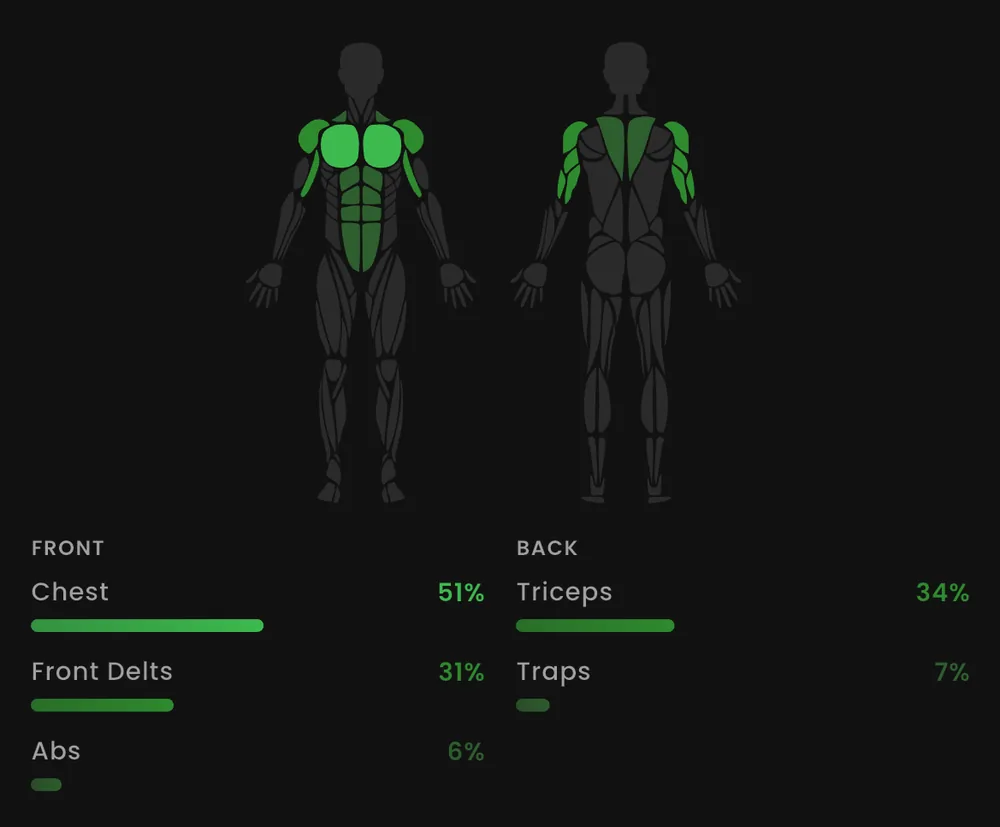
That’s a real push session logged in the app. Chest took the bulk of it at 51%, triceps came along for the ride at 34%, front delts at 31%, with traps and abs picking up the scraps. Anyone who has ever finished a session convinced they’d hammered their chest, only to find the next day that their shoulders took most of it, will recognise why this view is useful.
It’s genuinely helpful for spotting the things a training log obscures: the muscle you’re hitting four times a week without meaning to, the one you keep planning to train and never quite do, the reason your pressing stalls whenever you add another triceps exercise.
But we want to be precise about what that picture is. It’s modelled, not measured. It’s derived from what you logged, the exercises, sets, reps, loads and effort ratings, mapped onto known muscle involvement. It’s a very good estimate built from good inputs. It is not a direct reading from your body.
And the weakest input in that chain is the effort rating, for all the reasons above. It’s the one number in your training log that you invented.
What Korvi sensors change
This is the gap the hardware is meant to close, and fatigue is a good illustration of why we think it’s worth building.
The fair question is why any of this needs a sensor on your body. Velocity loss is already measurable by devices that clip onto a barbell, and the good ones do it well. For barbell bar speed specifically, a bar-mounted device is taking the more direct measurement, and we’d rather say that plainly than pretend otherwise.
What we’d push back on is treating bar speed as the whole of fatigue. It’s one signal, available only on the minority of your sets that use a barbell, averaged across both sides of your body. Those three gaps are most of what we’re building into.
Most of your training isn’t a barbell. Look at that muscle map again. A device clipped to a bar sees nothing on dumbbell pressing, cable work, machines or pull-ups, which is where a large share of most people’s weekly volume actually lives. If you want a fatigue picture for a whole session rather than a fraction of one, you have to measure the sets a barbell can’t reach. The velocity loss research is barbell-bound because the hardware has been, not because the physiology stops at the bar. Getting that measurement off the bar and onto the body is what we spent August on.
A barbell averages your two sides. It’s one rigid object connecting two limbs that are perfectly capable of covering for each other. If your left side is fatiguing faster than your right, bar velocity shows a mild overall slowdown and nothing else. Sensors on each limb see one side degrading before the other. That’s a left-right asymmetry signal that cannot exist in bar data at all, and fatigue is exactly the condition under which it tends to open up.
Fatigue changes how you move, not just how fast. The classic fatigued squat is the hips rising early and the rep drifting into a good morning. At the bar, that registers as a small forward drift and a slightly slower rep, the same flattening we described in our guide to bench press bar path. At the body, it’s visible as the work shifting from one joint to another. The same goes for range of motion quietly shrinking rep by rep. Bar velocity compresses all of it into a single number, and the number doesn’t tell you which of those things happened.
Fatigue becomes per-muscle and measured rather than inferred. The map above is built from your log. A measured version is built from what your body actually did during the session, including the sets where there was no bar involved.
And the plan can respond to it. We wrote previously about how Korvi’s training engine tries to distinguish a bad day from a plan that’s genuinely too hard. That judgement is only as good as the evidence behind it. Fatigue data measured rather than self-reported makes that a much easier call, and it’s the difference between a plan that reacts to what you told it and one that reacts to what happened.
We’re not there yet. The sensor system is in development and there’s real work between a prototype producing clean velocity data in testing and a product doing it reliably for thousands of people in noisy commercial gyms. We’d rather say that plainly than imply otherwise.
What you can do about fatigue right now
None of this requires waiting for hardware. Three things that work today.
Pay attention to bar speed even if you can’t measure it. You can feel the difference between a rep that moved and a rep that crawled. Use your first rep as the reference point for the set. If rep five is dramatically slower than rep one, you’re deep into fatigue regardless of what the rep count says.
Log your sessions properly, including effort. Imperfect data beats no data, and a subjective rating recorded consistently over months still reveals trends that memory won’t. This is what the Korvi app is for, and the muscle map only works if you feed it.
Watch the trend across weeks, not the reading on any one day. Accumulated fatigue is the one that creeps. If the same loads have felt progressively worse for three weeks, that’s a signal, and the answer is usually a deload rather than more effort.
And if you want to follow the measurement side of this as it develops, we publish a build update every month on what shipped, what broke, and where the sensors have got to. There’s a signup on the site if you’d rather have it as one email a month than remember to check.
Whatever you do with it, treat fatigue as information rather than as failure. It’s the thing that tells you the session worked. Managing it well is most of what separates people who train productively for years from people who train hard for six weeks at a time.
Fatigue has been treated as a feeling for as long as people have lifted weights, mostly because it hasn’t been practical to treat it as anything else. The science for measuring it properly has existed for years. The equipment to do so has lived in university labs. That gap is the thing worth closing.
Korvi is building wearable sensors for strength training, with full 3D motion tracking, the potential for bar path analysis, and AI-powered coaching. The app is free and available now on the App Store and Google Play. The sensor system is in development, with a Kickstarter launch planned for 2027.